The Eucharistic miracle of Siena: the Hosts that have remained incorrupt throughout the centuries.
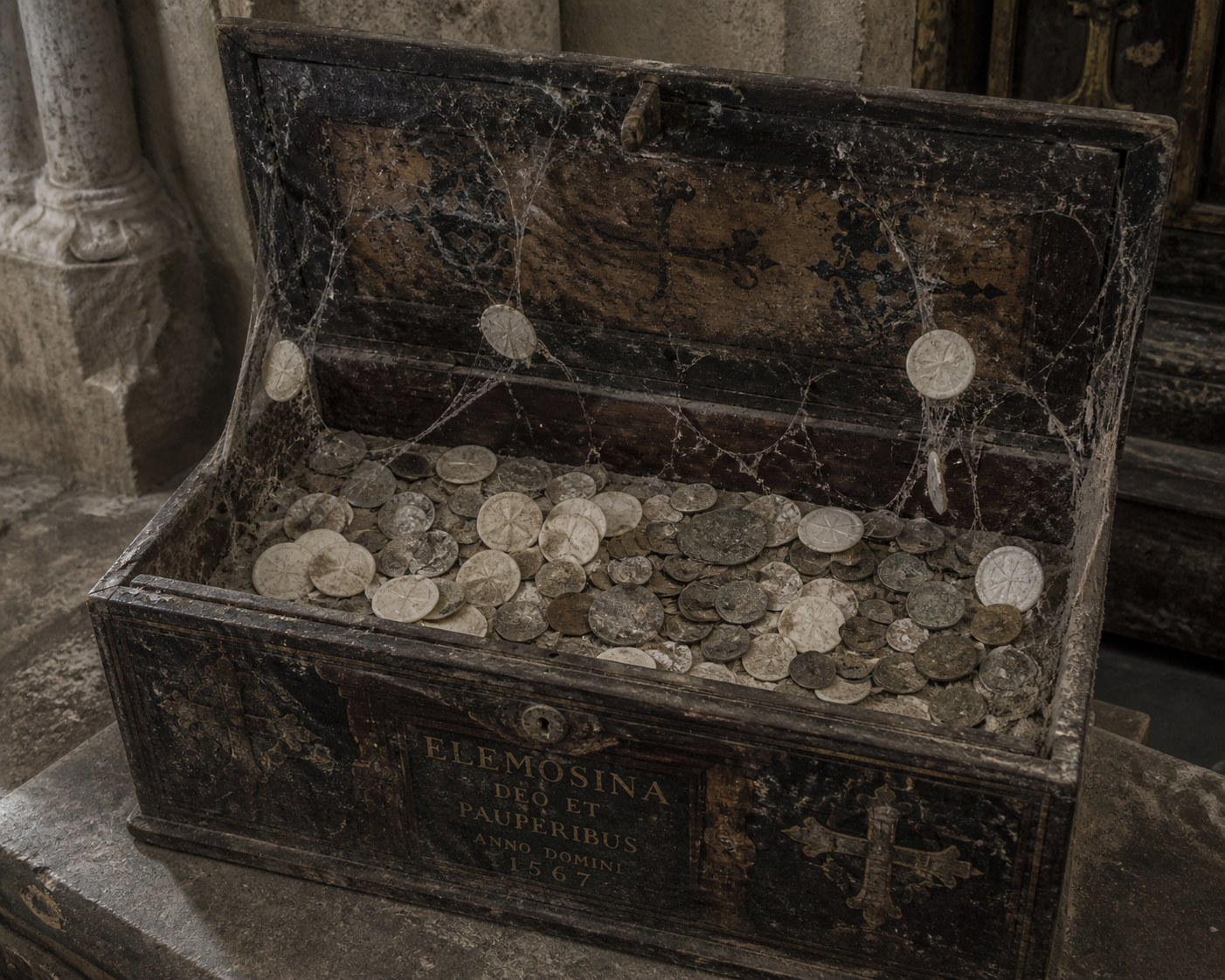
On August 14, 1730, in the city of Siena, on the eve of the Feast of the Assumption of Mary, criminals took advantage of the fact that the population and clergy were gathered for celebrations and broke into the Church of San Francesco .
They forced open the tabernacle and stole a golden ciborium containing 348 whole consecrated Hosts and six halves. The sacrilege was only discovered the following morning, leading to the immediate cancellation of the ongoing festivities.
The news spread quickly, triggering a wave of profound grief. Businesses closed their doors and authorities launched intense searches, while the Church called for acts of prayer and reparation.
Three days later, on August 17, a parishioner spotted something white protruding from the slot of an alms box in the Church of Santa Maria in Provenzano, located near the Church of San Francesco. Upon opening the container, the Hosts were found covered in dust and cobwebs, mixed with coins—a sign of the thieves' total disregard, as they were only interested in the gold of the ciborium. At the time, alms boxes were only opened once a year, which explains the accumulation of debris and dirt inside.
After being carefully cleaned, they were confirmed to be the stolen Hosts from the Church of San Francesco, as the count was exact (348 and six halves) and they matched the specific shapes of the irons in which they were baked. The Eucharist was returned to the Basilica of San Francesco in a solemn procession that mobilized the entire city. The Hosts were not consumed by the priests or the faithful because, despite the cleaning, they might still have contained impurities, and as they were the subject of prayers of reparation, it was decided to preserve them for a period.
The miraculous aspect emerged over the following decades. Under normal conditions, the Eucharist (composed only of wheat flour and water) begins to deteriorate and develop mold in a short time, especially in humid environments. However, the Siena Hosts remained fresh, incorrupt, chemically pure, and retained the scent of unleavened bread, defying the natural laws of organic decomposition.
Throughout the centuries, the phenomenon has been subjected to rigorous examinations:
- 1780 and 1789: Ecclesiastical authorities confirmed the physical integrity of the Hosts.
- 1854: Comparative tests were conducted with unconsecrated hosts, which became unrecognizable within a few years, while the Hosts from 1730 remained intact.
- 1914: The most famous examination, requested by Pope St. Pius X and conducted by professors of chemistry, pharmacy, bromatology, and hygiene from the University of Siena (including the renowned Professor Siro Grimaldi), concluded that the preservation was "an extraordinary phenomenon that eludes natural laws," ruling out any prior chemical treatment.
To this day, centuries later, the Hosts remain on display for veneration in the Basilica of San Francesco in Siena. During the Feast of Corpus Christi, the Eucharist is also carried in a solemn procession through the city streets.
The renowned physicist and scientist Enrico Medi, also considered a Servant of God and declared Venerable by the Vatican (in a decree promulgated by Pope Francis in 2024), expressed his faith in the Siena miracle:
"This direct intervention of God is a miracle (...) a miracle in the strictest sense of the word, performed and miraculously maintained for centuries, witnessing the permanent reality of Christ in the Sacrament of the Eucharist. In these times, so difficult for Christianity and the Church, when false doctrines resurface to undermine our faith, the city of Siena raises its banner and shows its miracle to the world."
References: Arcidiocesi di Siena, The Real Presence, Miracoli Eucaristici, Apostolado de La Santa Missa Diaria, @pocketterco, Cathopedia. Note: Image generated by AI.